News
Ian Flindell Joins Hayes McKenzie as Associate External Consultant
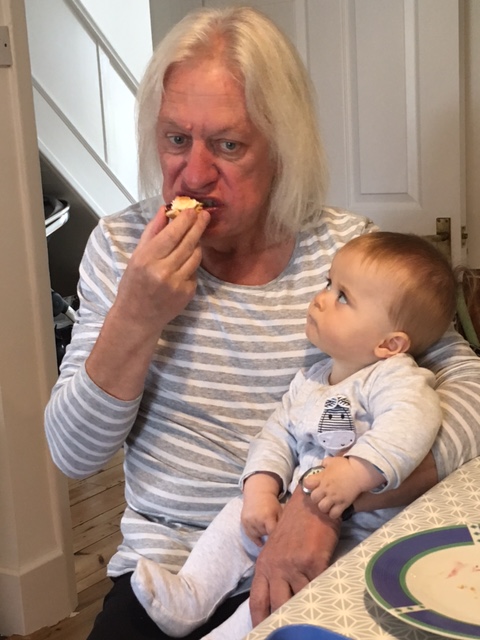
In April 2017 we were very pleased to welcome Ian Flindell to the Hayes McKenzie team as an Associate External Consultant. Andy and Ian first met when Andy was doing his under-graduate research project in Ian’s lab at ISVR in 1980 and Andy went on to work for Ian during his time as an ISVR Research Fellow in the late 1980s when Ian was on the academic staff. They carried on working collaboratively after Andy left ISVR to set up Hayes McKenzie, often on aircraft ground noise projects, and are very pleased to formalise their working relationship in this way. Ian has kindly provided us with a brief career history below:
My
best subjects at school were maths, physics, and engineering (and art), but
after my first year on the Engineering Science course at Reading University, I
was beginning to realise that I was more interested in the impact of science
and technology on people than just the science and technology on its own. Which
is probably the main reason why I ended up with a joint honours degree in
Psychology and Cybernetics. My developing interest in amplified music and audio
electronics then lead to my first �proper� job as a research technician in
Geoff Leventhall�s acoustics laboratory at Chelsea College in London where, in
addition to assisting with experiments on the effects of low frequency sound
and infrasound on people (among many other topics), I ended up with an MSc in
Applied Acoustics and a probably unjustifiably high degree of self-confidence. Instead
of staying on at Chelsea College to do a PhD, I decided instead to get a
postgraduate teaching qualification for further and higher education at the
nearby Garnett College in Roehampton, where, in addition to taking my self-
confidence to even higher levels, I learned how to present lectures, write competent
essays on educational theory, and conduct tutorials. I should perhaps add that
these have all turned out to be very useful skills for the jobbing consultant.
The
first job I was actually offered after gaining my PGCE was as a Research Fellow
at the Institute of Sound and Vibration Research (ISVR) at Southampton University
where I had funding to carry out research for my PhD under Chris Rice
who was then at the forefront of subjective acoustics research in the UK. My
PhD was mostly about alternatives to LAeq for quantifying aircraft noise, and
this is where I started questioning the then established wisdom regarding
standard acoustic metrics. The US government was then kind enough to pay for a
year as a Visiting Research Associate at the NASA Langley Research Centre in
Virginia where our three year old learned lots of new words such as �elevator�
and �candy� and we first encountered the �drive-thru� drop-off and collection
system at the nursery school! After I returned to ISVR, I spent some time
working with Peter Wheeler in ISVR�s new Auditory Communication and Hearing Conservation Unit which was set up to carry out consultancy
work and research in many areas of subjective acoustics and community response.
After travelling around a lot, helping to solve quite a few technical problems,
and encountering numerous administrative constraints and frustrations, I
transferred to the academic staff with my main responsibility to develop and
manage industrial short courses across the wide range of research topics and
interests covered by ISVR at that time. I
was also developing an independent research consultancy business to meet the
needs of clients who had no interest (at that time) in commissioning work
through the University, and which eventually expanded to the point where it was
contributing the greater part of my income and I felt obliged to reduce my
hours at the University to 50% part-time. I was now in an ideal position where
I had the best of both worlds. I was a member of the University, but still able
to avoid most of the, to my way of thinking, boring and frustrating
administrative meetings and other tasks that many academics seem to get
increasingly bogged down with these days, and at the same time, I was working
in the real world, helping people to solve real problems and to a considerable
extent getting paid handsomely into the bargain.
It
was while I was working as a Research Fellow at ISVR that I first met Andy
McKenzie where he seems to think I was possibly a bit dismissive at times about
his undergraduate project, but I don�t remember this. Andy stayed on under
Chris Rice to work on hearing aid design, and then starting working with me on
a number of very interesting projects such as; re-imagining automotive interior
noise; so-called wide imaging stereo; subjective response to different types of
photocopier noise, etc. etc. and all mainly funded by industrial clients. One
of our more interesting projects was an investigation of the possibilities for
detecting the faint breath sounds made by (or not made by) hospitalised
epileptic patients as a means of providing early warning of epileptic fits for
the night monitoring staff to be able to intervene and take appropriate action,
for which we had to devise specialist sensitive intercom systems. There was a
concern that break-in from external sounds such as night-time aircraft flyovers
could interfere with the detectability of target sounds, or possibly of greater
importance, the detectability of a lack of target sounds. Whilst our system
allowed monitoring staff to easily detect regular breathing and similar sounds
by simply listening in to each bedroom in turn, we found that the risks and
technical complications inherent in attempting to relieve the night monitoring
staff of what was actually quite an onerous task by any automatic system were
too great, irrespective of interference by any external noise source.
Another
typical project involved forensic testing (for a BBC Panorama
miscarriage-of-justice investigative journalism programme) of the credibility
of evidence given by prosecution witnesses at a murder trial that they had �heard� screams from inside a flat on a cold
night some considerable distance away from the flat where the alleged murder
took place and this was their explanation for venturing out, calling at the
crime scene, and witnessing the violence. We recorded an actress re-enacting
the alleged screams, and I then toured the area with a sound level meter, a BBC
film crew and a walkie-talkie radio in communication with Andy who remained at
the crime scene equipped with a big loudspeaker system and a calibrated attenuator
to find out by just how much a typical scream would need to be amplified in
order to be even just about audible at different distances. We showed that, irrespective of whether they
had in fact witnessed the murder or not, their story that they had been alerted
by hearing screams from inside their flat was not credible. The convicted
�murderers� were eventually released following an appeal, but the true culprit
was, unfortunately, never found.
Andy, of course, went on to develop a thriving
business at Hayes McKenzie with Malcolm Hayes mainly specialising in wind
turbine noise and related topics, but we continued to work together on major
airport development and similar projects, often involving extensive field
monitoring surveys and computer based modelling techniques. For myself, in
addition to continuing with my University teaching and research and independent
consultancy work, I found myself increasingly sucked into committee work on
standards and regulations, which unfortunately, can require considerable
stamina to see worthwhile progress being made. With other partners, I
contributed to the design and interpretation of a major aircraft noise annoyance study for the UK Department for Transport (ANASE) which, although many of its findings
have since been supported and substantially replicated internationally, was not
accepted by the project sponsors. This lead to a number of interesting, and
shall we say �challenging� debates in public meetings and presentations, which
I regret to say, did not enhance the reputation of the more conservative
components of the DfT at that time. We also learned the benefits of thinking
through all the possible ways in which detractors might be able to criticise a
study, and ensuring as far as possible that appropriate justification is taken
into account in the design. This can be difficult when carrying out original
research because it is not known in advance how the results will turn out; but
that is inherent in the nature of original research. I have also become much
more attuned to the potential differences between academic research, where the
possibility of apparently contradictory results should be anticipated and even
welcomed, and applied research, where a research sponsor, if not adequately
prepared, can sometimes be disappointed by unexpected results which in more
extreme cases can be viewed as undermining existing policy. This a potential
ethical issue, where maintaining integrity can be (or should be) more important
than client satisfaction, and a point which I feel probably justifies more
attention within our industry than it presently receives.
And
of course, I have been delighted to note that Hayes McKenzie have, over the
years, maintained a similar approach to business ethics and personal integrity
as my own. And that is one of the main reasons why I have been delighted to
have my long-standing working relationship with Hayes McKenzie recognised by my
being invited to join the team as Associate External Consultant.
by Ian Flindell