News
WTN 2017 – Full Conference Review with Dr Andy McKenzie
Every two years some of the Hayes McKenzie personnel
find themselves at the INCE-Europe international conference on wind turbine noise. The conference has been running since
2005 when it launched in Berlin and has since been held in Lyon, Aalborg, Rome,
Denver, Glasgow and, this year, Rotterdam. Malcolm and Andy have, of course,
managed to get to all of these conferences but virtually everyone now at Hayes
McKenzie has been to at least one. In 2011, all our consulting staff went to
Rome, which made Hayes McKenzie party-central for any extra-curricular
entertainment which was going on and this tendency seems to have continued
although this year it was the lean-team of Andy, Malcolm and Mike who attended.
There were, of course, plenty of our old friends from the industry to catch up
with however.

The Venue
Rotterdam is the city which supports the largest port in
Europe being the point at which the Rhine hits the open sea and the conference
was held in the city�s Willem Burger complex which is specially designed for
conferences and corporate events. The conference ran from Tuesday 2nd
May to Friday 5th; the only parallel sessions were on the Thursday
so, apart from that, everyone heard the same talks. There were also a number of
�posters� to provoke debate during the tea, coffee and lunch breaks.
Day 1 (Tuesday)
The conference was opened by the President of the Acoustical Society of the Netherlands
which was followed by the first session on �Perception and Health Effects�
looking at masking of wind turbine noise by other ambient sounds, dose-response
and a video on the potential noise effects of sub-urban wind turbines from a
speaker who couldn�t attend in person. There was some discussion on the effects
of the choice of noise index for appropriate quantification of turbine noise.
After lunch was the first session on source noise with
the first speaker presenting on the special considerations required for the
implementation of Edition 3 of the wind turbine source noise testing standard
IEC 61400-11:2012. The second speaker had a cunning method for deriving turbine
rotational speed, and hence output power from the amplitude modulation (AM) signal
at the blade passing frequency. The fourth focussed on the effects of trailing
edge serrations and the dramatic improvements in noise performance which can be
made with their application. After a tea break Richard Perkins, the author of
the recent study for DECC
on AM, opened the first AM session with a discussion of the work carried out.
This was followed by a presentation on the correlation of AM with environmental
factors and one on how wind noise in microphone can have a significant effect
on measurements if not properly controlled or otherwise accounted for.

N.B. If you�re
interested in learning more about IEC61400-11 sound power level testing or Amplitude Modulation (AM) analysis, check out some of our articles on these topics.
After the usual Q&A discussion which followed each
session, delegates assembled for a drinks reception and introduction of the
posters. After a few beers and tasty Dutch snacks delegates checked-in briefly
with their accommodation before those from Hayes McKenzie lead the quest for a
tasty Dutch dinner ending up in a fabulous bistro burger bar attached to Rotterdam�s
central market.
Day 2 (Wednesday)
The second day started with two further sessions on
�Perception and Health Effects� with presentations by Fritz van den Berg and
Geoff Leventhall, both veterans of this conference series. We were there with
Geoff at the start in 2005, Berlin, when he was the main organiser, until Dick
Bowdler took over leading up to the Glasgow conference in 2015.
These sessions marked the first of the presentations on
�infrasound�; sounds which are very low in pitch but also significantly (orders
of magnitude) below the established perception threshold for humans. This is a
controversial area with objectors claiming to be made �ill� by these
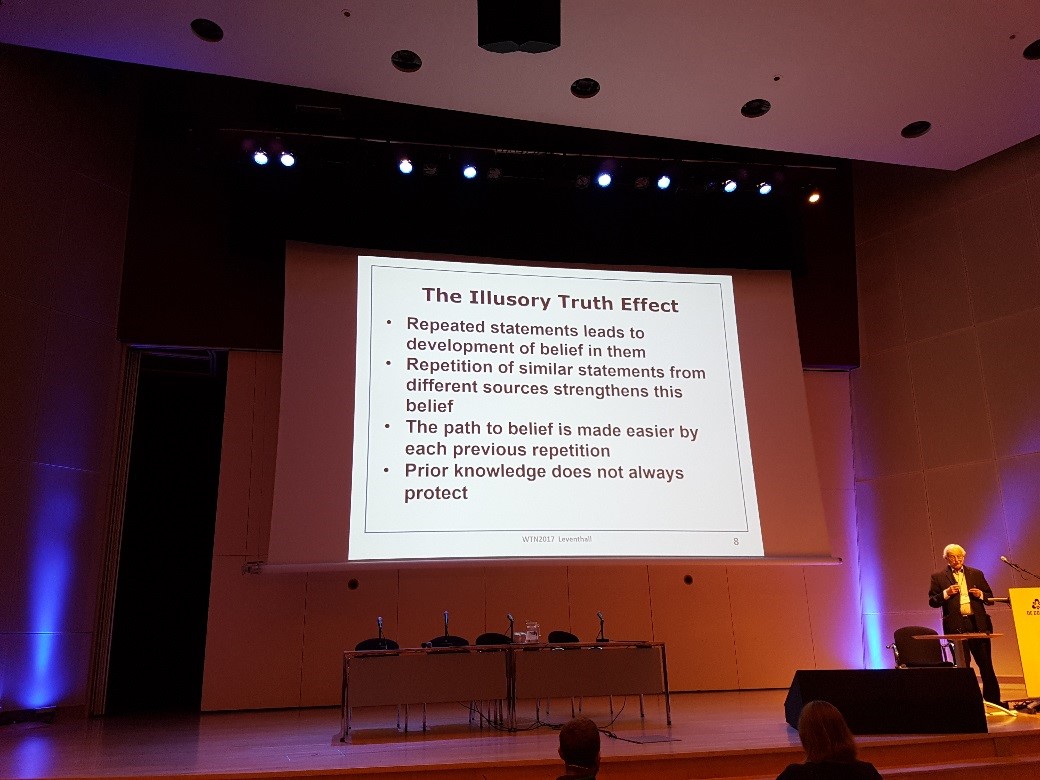
imperceptible sounds. Geoff�s robust paper likened this to the �illusory truth effect�.
After the second of these sessions, Matthew Cand from Hoare Lea presented a workshop on
control of AM including the use of cyclical pitch control which allows the
blades to continually change pitch independently as they rotate. This not only
prevents them intermittently �stalling�, thus causing AM, but also improves
efficiency.

After lunch, and rather bizarrely, Sylvia Broneske,
formerly of Hayes McKenzie, chaired a session on �Shadow Flicker� which,
despite not being related to noise, some acoustics consultants also offer. Andy
decided to skip this and, along with Gavin Irvine from Ion Acoustics, found a rather
impressive cheese shop (and also a bar).
After some further exploration by Andy and Gavin, the
penultimate session of the day was on �International Perspectives� with
presentations from Chile, India and Argentina which highlighted the
difficulties of applying the prescribed methodologies for �normal� industrial
noise to wind turbines which have the peculiar characteristics of changing
noise level with wind speed against ambient noise which also changes with wind
speed, particularly in the kind of areas where wind farms are built. A theme
which also came up, and which comes up regularly at these conferences, is the
difficulty of quantifying noise at the low levels at which wind turbine noise
occurs.
The day ended with a workshop on the poster subjects;
sound propagation, background noise and regulation presented by Sabine von
Hunnerbein from Salford University followed by an expedition to a Chinese restaurant where we
commandeered a whole room to ourselves for our group, ending the evening with a
table football contest between Hayes McKenzie, Ion Acoustics, WSP Parsons Brinkerhoff and Accon UK in the hotel bar.

Day 3 (Thursday)
The main hall on Thursday contained presentations on
�Assessment and Compliance�, �Low Frequency and Tones� and �Infrasound�. The
other venue was concerned predominantly with the modelling of aerodynamic noise
on the blades.
The main hall started with two sessions on Assessment
and Compliance and the first paper, from Accon UK, presented a review of wind
turbine noise assessments carried out for Scottish sites and comparisons with
the study by Hayes McKenzie for the (then) Department of Energy and Climate
Change which led to the publication cation of the Institute of Acoustics Good Practice Guide. This was followed by varied selection of papers ranging
from one advocating the participation of local residents in wind turbine noise
assessment work, two which looked at noise �dose� over a year (this is used in
Switzerland, Norway and the Netherlands), although the Dutch paper on this
reported on a site where the local authorities had imposed strict limits,
related to background noise, to be met in practice. Two papers looked at ways of �removing� the
influence of general ambient noise to get a true picture of turbine noise for
the assessment of an operating site and a paper from the turbine manufacturer Siemens,
scheduled at the last minute following a non-attendance, looked at the effects
on turbine numbers and layout of prescribed prediction methodologies and
regulations in different countries.
After lunch, things continued with low frequency tones
and infrasound. The first 3 papers on low frequency tones were more concerned
with the way this is essentially re-radiated vibration and the ways this could
be managed. A Japanese study, which was also the subject of one of poster
sessions, presented the new wind turbine noise assessment methodology
applicable in Japan which required no more than a 3 dB correction for toners
and no penalty for AM on the basis that this is an inevitable part of wind
turbine noise (pretty much what ETSU-R-97
concluded in 1996!).
The final session on infrasound concluded with a
scrupulously measured and presented study on infrasound components and blade
passing frequency and its harmonics, all of which were at least 60 dB below the
threshold of perception (ie. containing about a millionth of the energy
required to be perceptible by humans). The day�s papers rounded with a
presentation on measurement of aerodynamic noise on the blades themselves and
the microphone technology required to achieve this.
Thursday evening was the conference dinner, on board a
paddle-steamer going a little way up the Rhine and back, followed by more Table
football and the lucky discovery that beer was obtainable from a vending
machine after the hotel bar had closed.

Day 4 (Friday)
Friday was the last day and started with two sessions on
amplitude modulation kicking off with an Australian paper showing exceptionally
high levels. RES presented a review
of factors which had been shown to cause AM, although the following paper from
Canada concluded that nothing was found which correlated with the prevalence of
AM.
The second session started with Dave Coles from 24 Acoustics explaining the UK
Institute of Acoustics AM quantification methodology, which many from around
the world have clearly been using since its publication last year, followed by
a presentation from Japan comparing this with the Japanese method which is
rather less robust in considering all modulating noise rather than just that at
the blade passing frequency. The session was finished by Krispian Lowe from Innogy, shown above with Dave
Coles, who showed the effects of putting it into practice alongside a proposed
AM �penalty� from Richard Perkins� earlier talk.
Just before lunch there was a presentation from a Dutch
miller on the history of windmills in Europe and his own personal experience of
noise control.
The last session after lunch was the second on source
noise with a paper from Canada showing wind shear to have little or no effect
on source noise levels. The conference concluded around 15:00 with some
delegates staying on for the week-end and some making their way to trains and
planes home.
See you all in two years. Hawaii anyone?
By Dr Andy McKenzie